
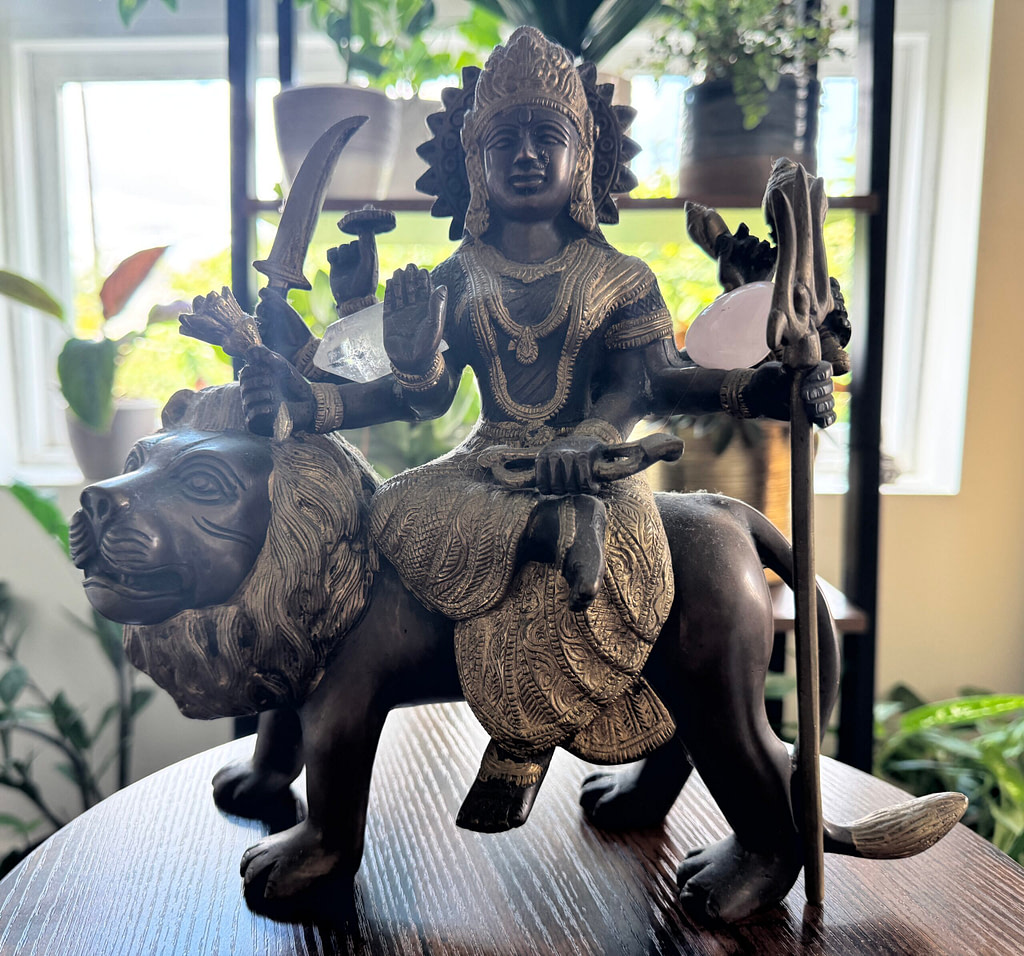
There is a goddess for tough times. She yields a sword and rides a lion, has eight arms, and is radiant as the sun, the moon, and molten gold. She’s soft and loving, fierce and dangerous, beautiful and brave and badass. Her mythology inspires and empowers, reminding us to be adaptable and resilient, to cultivate courage in the face of crisis, and to stand strong in a collapsing world. The meaning of Hindu goddess Durga is a multiplicity, and a complexity of being.
Durga’s multitude of meanings is a medicine for this difficult historical period, characterized by over simplistic, fast paced “solutions,” superficiality, and binary thinking.
Her presence invites us to cultivate courage in turbulent times. She is the inner energy that can get us through the trenches. She’s our ability to make the journey valuable, meaningful, and beautiful – even as we move through the most challenging experiences.
Durga is the call to be tough, without losing tenderness. She’s our capacity to take charge in times of upheaval, and offer strength, support, comfort and compassion – to ourselves and to others. She is the invitation to step into our power, hold steady, and adapt to the circumstances as needed.
Here’s a video that explores a few aspects of Durga, with a mantra and mudra meditation practice to embody the goddess:
Durga: Meaning and Symbolism of a Powerful Goddess
This goddess shows up when the world needs a new power to break through the stubborn forces that keep things stagnant. Made of light emanated from all the gods together, Durga is born to come up with a different way of doing things. She’s embodied as diversity, as collectivity made of a variety of personalities, ideas, stories, and perspectives.
Sometimes she has eight arms, and sometimes she has ten, which tells us that when it comes to Durga, reality, identity, the world, life – nothing is fixed. She’s not a goddess in her consorted form – those usually have only two arms. She doesn’t have four arms like most other goddesses who take the form of their autonomy. Her eight arms tell the story of a goddess whose role is to bring renewal to the world, a fresh view, and a new kind of leadership.
The gods come together. They stand in a circle. They gather as a community. They realize that this is not a job for one individual. In order to overcome the buffalo demon, Mahiśasura, who is a massive bully, they need to work together, and create something new as a collective. The old ways won’t do.
Go here to read about (or to listen to) this part of the myth, and how it relates to your strengths.
Durga the Warrior Goddess
Durga is most known for being a warrior goddess. She is the strength we need when we face adversity. She’s empowerment in moments when we feel we have no agency. She’s the ability to rise and meet a persisting challenge in a new way, to not give up, and to keep trying different approaches. The spirit of the warrior is tenacious.
The warrior archetype is the part of us that shows up fully – for ourselves and for others. She stands for what matters. She speaks up. She gives voice to the ones who have no voice. She fights for freedom, but she seeks to not harm.
Hindu goddess Durga is protective. She is a guardian. She is the stable and adaptable presence of the warrior archetype.
The warrior archetype is fierce. She knows how to channel her ferocity. To be a warrior requires training, discipline, commitment, and the capacity to rise after you fall. Failure isn’t a failure in the heart of the warrior. There’s trying, there’s learning, there’s rethinking, and there’s re-emerging.
She’s the tenacity of Spring – rising again. The ferocity that brings renewal from the frost.
When the season of Spring arrives, and the sign of Aries spins the wheel of the Zodiac into another round, Durga is a rich archetype to invoke.
I wrote a Substack piece about Durga and Spring. You can read it here.
The Meaning of Goddess Durga is Woven In Her Name
The name Durga means; tough going. Durg, in Sanskrit means; Fortress.
Dur in Sanskrit is; hard, tough, difficult. Gam is the Sanskrit verb root; to pass.
Durga can mean; Fortress. Something difficult to pass. Something that’s very hard, or even impossible to defeat. Durga is often translated as; invincible.
Goddess Durga is tough. And she is also the courage to go to the tough places where doing the work of transformation is most needed – a journey that isn’t necessarily safe.
In this toughness, there’s vulnerability. A passageway. An entryway. A cave. An opening. She’s hard to pass, no doubt, but when you study her mythology you discover that her way of fighting never excludes the receptivity and softness of her femininity.
She reminds us that to be tough IS to be tender. Vulnerability reveals possibilities rather than certainties, and that is the very key to our ability to resist tyranny.
Sometimes what helps with the energy of stuckness, stagnation, and immovability, is a re-orientation, a different way of looking at things, a new way of thinking about the situation, and a soft, tender presence with the stubbornness. If you’re feeling stuck right now, I want to quickly invite you to a five session journey, to help melt the hardness, and build a meaningful space for your creative energy. The journey from Stillness to Spark is here for you if you want to transform stuckness into a sacred sanctuary for inspiration. Learn more and sign up here.
The Buffalo demon of stubborn certainty in the Durga myth, is defeated by her feminine power. After a long battle, that includes many details, Durga is known to place the soft part of her foot on Mahiśasura’s head, and that softness melts him. Some say that the secret to his reabsorption in the earth, is that when Durga places her foot on his head, he gets a glimpse of her feminine parts, and that is what melts him.
So she’s badass! And impassable! And she is also a gateway, a threshold, an opening. It’s just that not everyone is invited through that passageway, or into her womb.
Mother Durga: The Womb and the Cave of the Heart
While she is the ultimate boundary creator, she is also the mistress of inclusivity. She is ready to ride her lion into battle and destroy the harmful demons of authoritarianism, of racism, of bigotry, of misogyny. Ready to penetrate and puncture closed mindedness, shift immovability, change paradigms, and break conventions. And she is also the mother of everything. Her womb holds us all in deep love.
There’s a paradox that pulses in every cell of Durga’s symbolism. And that is why I love her so much!
Durga is made by all the gods together. And she is also the mother of them all. She is The Great Mother. That which holds the whole universe. To make this extra interesting, she is also the mother of demons. Everything is held in her. Durga is Kali.
She is even the mother of her own self. After she’s made, she doesn’t go directly to battle. She first takes herself to a cave, and in that cave she crafts and creates who she is. She engages in deep practice, in profound contemplation, in hours upon hours of daily meditation. She chants. She dances. She does asana and pranayama. She reads books and more books. She studies. She learns Kung Fu, and Jiu Jitsu, Karate, Qigong, and Tai Chi. And she rests.
The cave is the womb. It’s a nurturing place. It’s a soul nourishing, brain feeding, body strengthening space. When she comes out of the cave she is ready for battle. She’s mature. And she is fresh. She is wise and focused and blazing with beauty and the heat of transformation.
The cave is also the heart. The center of who you are. The pulsing power of existence. The source of love.
When we face an inner conflict we can no longer ignore, when we encounter a tipping point moment in history, we gotta go into our soulfulness, into the deep cave of our care. We have to root into what we care about, into why we must rise to the occasion and not fall into despair. Even when we find ourselves standing in front of a harmful force, we have to find our heart in the situation – not to love that which harms, but to anchor in the love that shapes us into the protector.
Love is at the core of Durga. I want to be very clear: I don’t mean love as fluff. I don’t mean it as a way to bypass the rage over injustice, the forces we must battle, the pain in struggle, or what’s actually going on. Love serves as the reminder for why we must rise against certain forces.
Durga is our motherly tenderness, our warrior mama-bear protectiveness. Womb nurturing. Inclusive embrace. Big heart care.
She is a goddess who takes the form of a woman. But she is also the whole of the cosmos. She is the earth. She is the mother of all living beings. It is she who receives Mahiśasura, the Buffalo Demon, to be reabsorbed back into her.
The Trishul: Durga’s Weapon and a Triple Goddess Symbol
Durga is often depicted with one of her eight or ten hands holding a trident; Trishul in Sanskrit. This is the weapon she uses to pin Mahiśasura to the ground. She then places her foot on his head, reveals her yoni (Sanskrit for the reproductive organs of the feminine), and he melts into the earth.
In Durga symbolism, the Trishul tells us that she is a triple goddess – an archetypal feminine power that shows up in many ancient cultures. It reminds us that she holds more than one identity. It tells us that she is a shapeshifter. And it roots us in the ancient triad of Maiden-Mother-Crone.
She is the cyclical nature of life. She is the seasons. The earth’s spinning around the sun. The phases of the moon.
Durga is the renewal of Springtime. She comes as a breath of fresh air, as a paradigm changer, as the fire of transformation, as the wind of renewal. She’s a new wave. She is the power that pushes the plant through the boundary of the earth, and sends it up toward sunlight. She is the goddess of creation.
As the mother, the protector, she is also the sustainer. She keeps the world going. She stabilizes the forces of nature. And she also fights the demon of stagnation – her stabilizing power is made of the energy of change.
Her ferocity places her on the throne of the crone. She carries the wisdom of the Dark Feminine archetype. Durga and Kali are aspects of one another. Her intensity is woven with her compassion, her ferocity is tattered to the power of renewal. She’s a destroyer – a demon slayer. She brings death to certain aspects of self. She brings the end to certain currents within the culture.
We know that death nourishes life. We know that whatever dissolves into the earth fertilizes the soil, and makes way for the continuation of life. Death. Rebirth. Life. Death. The Trishul is the triangular nature of reality, which reminds us that complexity is at the base of life. That life and death are ever intertwined. That existence is cyclical. That creation doesn’t exist without dissolution.
The Complex Constellation of Goddess Durga Symbolism
There is a rich fabric woven of Durga symbolism. So many pieces that tell us the story of who we are. Painting a poem in the language of the soul. Evocative. Prismatic. There are more symbols and aspects of her iconography than I can include here, in this essay. I’ll weave together a few…
The red of her Sari is the blood that tells the story of the three archetypal phases in a woman’s life. It also stands for the blood shed in battle, for the intensity of her role, for the violence woven through all of existence. Blood is a primal, primordial stream, and she wears it as her Sari, which is symbolic of refinement and sophistication.
The lotus that she holds teaches us about the inseparable link between deep mud and the beauty that rises from it, between dark times and flourishing, between the unconscious and the glory of art.
Durga’s sword teaches us to cut through the bullshit, to be discerning, to protect ourselves, and to hold our center with steadiness. Her discus reminds us again that life is cyclical, and spins a path of well roundedness. The water pot she holds is a nod to the womb, to the cave, to the Mother. The bow and arrow orient us around intention and aim, goal and core, attention, focus, and clarity of mind.
She holds a Vajra – a thunderbolt (and a diamond) in Sanskrit – which invites us into our capacity to blaze with our power across the sky of our lives, to be fierce like lightning, to be a fireball when we need to. It reminds us that we are the indestructible power of the diamond.
There are countless more symbols, each deserves their own essay. Symbolism is such a powerful way to make meaning, to remember our strengths, to tend to our shadow, to do the work that we need to do with ourselves and with one another.
In a time like now, listening to stories, learning about archetypes, and collecting the wisdom held in symbols, is important. It’s a practice that helps open up our minds. It supports the renewal process so necessary right now.
Mythology helps us battle Mahiśasura, the demon of stagnation and certainty. Symbolism lets us spin the thread with which we can weave together a new fabric. It invites us into the cave, to do the necessary deep inner work. Durga style.
For another exploration of Durga and your power, read this.
If you are struggling with stuckness right now, and you feel like the buffalo demon is defeating you, I warmly invite you on a journey – From Stillness To Spark – a five session cocoon to give you space to reorient, so that you can carve your path to rebirth. It’s a somatic practice space, a breathwork sanctuary, a contemplation temple, and sacred container for inspiration. Learn more and sign up here.
With so much love,
Hagar