
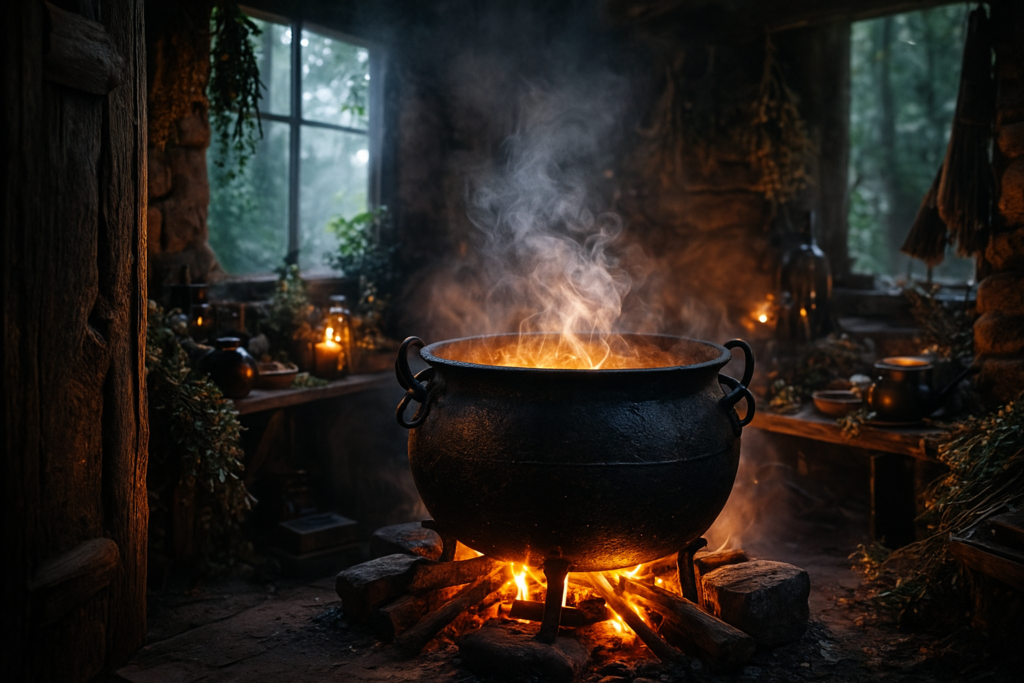
In the dark season, when the light dims, and the sun submerges in the depths of the soil, evocative archetypes come out of the shadows. Goddesses from all around the roundness of the earth emerge out of the oceans, rising from the unconscious, from murky waters of deep dark ponds in deep dark woods. Fearsome characters are often complex. They arrive in stories as catalysts of change, of death and rebirth. The dark feminine archetype often shows up as a tomb that is a womb. Sometimes she arrives with a cauldron. There’s a lot to think about, to imagine, to dream, and to feel when it comes to Cerridwen’s cauldron of transformation.
Celtic goddess Cerridwen embodies the great power of magic. She stirs the cauldron of regeneration and ignites the spark of inspiration. She is not a simple lady. She might eat you! But will also give you new ways of life. She will take you through a process of deep alchemy. Apprenticing with this dark goddess of transformation will not be easy, but you will become wiser, stronger, more soulful, wilder in imagination, and more creative.
If you feel the pull to slow down, to learn deeply, to turn inwardly, to listen to plants, to live more poetically – even in the midst of upheaval, and maybe especially as the world falls apart – Cerridwen’s cauldron of transformation is calling.
I’m writing this in the darkening days of December. The mood is fertile for alchemical processes. The year is ending. The sun is dying. But this is not just for this season. Cerridwen is the archetype we need right now because she invites us on a deep journey. She’s not an archetype for simplicity. She’s a goddess for deep thinkers, for philosophers, for people who are interested in participating in composting; in turning that which has fallen off, or that which needs to be dropped, into fertile soil for new growth.
We know the sun will be reborn after the solstice, we know that renewal is coming, but before the rebirth we must let things die. Cerridwen’s cauldron of transformation is where we do the work. And where we rest.
Who Is Cerridwen? The Celtic Dark Goddess of Transformation
Cerridwen is a wise, witchy goddess from Wales. A goddess of enchantments, change, cycles, and inspiration. She is the keeper of the flame of transformation under the cauldron of regeneration. In her most famous myth, she brews a most powerful potion – just a drop of it can turn someone into the brightest and wisest of souls.
She is a crone goddess; a wise elder whose knowledge of the land and the herbs, of spells and enchantments, of alchemy and creativity is vast. But she is not limited to her role as a crone. She is also a triple goddess; a lunar deity who can appear as maiden, mother, or crone, a wild woman who can transmute and shapeshift, a deity who can move between fullness and emptiness, embodying liminality, and phasing in and out of forms.
Working with Cerridwen mythology can help us see some of the experiences we go through as deeply empowering. It can help us stir meaning in the cauldron of life, learn to look at situations through different lenses, and ignite the magic of rebirth in times of struggle, loss, and worry. Personally and collectively.
Cerridwen’s Role in Welsh Myth and Magic
She is the goddess of metamorphosis, of deep change, of working under the surface of things. She is goddess of the cauldron, stirring the power of the womb; the power to choose, to receive, to generate. She is the power of the earth to nurture a seed. She is the power of death and decay, of deep underworld currents that transmute; breaking down a body so it can nourish other things, the power to release in order to recreate, to sustain, to continuously become by breaking.
The legend says that she lives in a lake, in the land beneath the waves, in northern Wales. She pulls her magical cauldron from the deep dark waters of Annwvyn – the underworld of Welsh mythology. And she brews the potion of Awen.
Awen might be what Cerridwen is most known for. It is the spark of inspiration, the power of creativity, the song that brings life into being. The praise of inspiration praising its own inspired spark.
Historically speaking, according to Kristoffer Hughes, Cerridwen didn’t originate as a goddess. There were no cults centered around her, there were no temples found, no invocations or prayers to her as a goddess that we can point back to today. And yet to the bardic schools of Wales, Cerridwen functioned as a most important core.
Celtic goddess Cerridwen is the breath behind ballads, the energy that invites and ignites inspiration, the power and pulse of poetry.
While according to Hughes she is a much more beloved of a goddess now than she ever was before, and while Wales is not the center of her worship anymore, it is still the land of her origin. And her relationship with the Order of the Bards is deeply rooted in Welsh soil and stories.
Why Her Archetype Belongs to the Dark Season
In her cauldron of transformation, Cerridewen brews a most potent potion for a year and a day. It’s for her son, who is – how should we say it – not the brightest or kindest or handsomest of the bunch. She’s worried about him. Will he ever be accepted in society? How will he have a good life? She knows how the world works. She wants her son to have a chance. No school works for him. He has no friends. He’s bullied by people. And he’s kinda mean too. She’s feeling like a failure as a mother. After years of sleepless nights, she decides this potion is the solution.
The reason behind this powerful spell is layered and relatable – a mother’s worry, personal struggles, a desire to fix things, as well as a deep, basic need to belong, and anxiety about our children’s need to find their place in the world. It opens up a window into universal themes of human problems, giving us access to collective shadow, offering us an opportunity for pondering and questioning. Would I meddle with life in this way?
The dark season pulls us into the cauldron of contemplation, into a process of self reflection, into the interrogation of the unconscious.
This story pulls us into the human grapple with the shadow.
Cerridwen’s daughter is fabulous. She is full of light and wit, intelligence and radiance. She is the sun, the beams of beauty, the brightness of day. While her son is known as the ugliest, most hideous and foul of beings. He is known as utter darkness.
Her children are like Greek Apollo and Python, or Egyptian Osiris and Set. In those stories there’s rivalry between siblings. In Cerridwen’s story, the mother wants to dispel the darkness not by killing her son, but by transforming him from darkness to light.
Like many mythic mothers of the dark feminine archetype, Cerridwen is the source of both light and darkness. She has deep ties in the underworld. She breathes in the shadows. She knows how to dance on both the sunlit, sparkled surface, as well as deep in the subterranean landscape of transformation.
Cerridwen’s Cauldron of Transformation – Leading Up to Winter Solstice
The dark season – the weeks that surround the Winter Solstice, as well as times in our lives when we experience light fading into gloom – take us into a process of release. There’s a shedding. There’s composting. And we’re invited into a process of integration, into the burial mound that is also a uterine shrine. We’re in the cauldron of regeneration.
When we connect to the cycles of the earth, to the seasons, to the phases of the moon, we make room for the darkness. We learn that death and rebirth are intertwined. When we arrive at the dark season, we invite and we invoke the ability to tap into potentiality and excavate it, bring it from the depth into the surface, and usher it from seed into growth. This process always involves a journey into the land beneath the soil or the sea, to the places where the unseen becomes seen, to the dull, dim gloom of the weeks that lead to Winter Solstice.
Cerridwen’s Cauldron of Transformation – Dissolving to Become
Cerridwen teaches us how to transform in the dark; authentically, truthfully, courageously. Her mythic metamorphosis is not linear. The transformation she seeks is not the one she gets. Does that remind you of something? Doesn’t it ring the bell of life? When you set intentions, craft goals, make resolutions, how does reality actually shape? Isn’t it often so different from our dreams?
Dissolving to become is the process of breaking down who we’ve been in order to fertilize the process of restructuring who we are. As the universe breaks open and moves further into entropy, particles coalesce and new forms are made. The dissolution happens all the way on a cellular level, all the way in the depth of our intentionality.
In the cauldron of transformation, even our intention to change will go through a process of melting, unbecoming, breaking down. What we want to shift may not shift in the way we want it to, and something else – something completely different – will undergo a complete makeover.
The Alchemy of the Cauldron
Cerridwen sets on a journey to help transform her son’s darkness into light. How else will he ever be received in the world, being so horrible – inside and out? She gathers herbs and roots and fungi, flowers, seeds, and bark, and makes a magical brew in her cauldron of transformation, calling on the sun, the moon, and the stars to help her alchemize the dark. The potion needs to brew for a year and a day (a magical time for a powerful spell in Druid myth and magic), and must be stirred constantly. Then, three drops of Awen will appear, and the tongue that will taste them will turn that person into the brightest, wisest seer and bard.
Two people help her stir the brew; an old blind man named Morda, and a young peasant boy named Gwion Bach. For a year and a day they stir and stir. At the moment when the brew ripens, Cerridwen isn’t there. Where is she? We don’t know.
When the three drops of Awen appear, Gwion Bach is there, and different versions of the story give us different reasons for why he is the one who ends up drinking the potent potion of cosmic creativity and divine inspiration. When I was first told this story, I heard that the three drops were hot as fire, and that they leaped out of the cauldron and landed on his thumb. Without thinking, he placed his thumb in his mouth to cool it down, and Gwion Bach was filled with deep wisdom, endless intelligence, divine inspiration, and a deep understanding of the vastness of the universe.
Oops. Wrong mouth. But is it?
Dissolution Before Renewal
The story ahead of us is a long and winding road. Cerridwen is about to discover what happened and go bananas, and chase Gwion Bach across land and sea, sky and song. Her rage is as fierce as an earthquake. Her grief is groundbreaking. Her ferocious anger is not to be messed with. And poor Gwion Bach knows he’s got no chance – after all, he just drank the three drops of Awen, so his understanding of the situation is acute.
Cerridwen’s cauldron of transformation played a trick on its witch, didn’t it? Instead of dispelling her son’s darkness, it has dissolved her dream of his transformation. The rebirth that she envisioned just gave her a death. Wouldn’t you be mad?
She’s seeking revenge. She’s after destruction. She’s not gonna let this slide.
We’re not gonna tell the whole story in all its details right now. We’ll keep unpacking this great tale in the next few weeks. But what happens next serves us an important lesson; Rebirth requires being swallowed first. Renewal needs a process of deconstruction.
Why the Dark Is Necessary for Becoming
Spoiler alert: Gwion Bach will become the great Welsh prophetic bard, Taliesin, whose character is intertwined with that of the great wizard, Merlin.
But before this metamorphosis, Gwion Bach will try to escape the goddess and discover that the power of Awen gives him the ability to shapeshift. He turns himself into a hare, trying to escape the wrath of the goddess. But she too is a shapeshifter, and transmutes into a greyhound, running after him as fast as a cheetah. He knows he has no chance as a hare. His feet carry him to a stream, and he jumps in and becomes a salmon. The goddess of witches, with the fire of fury propelling her forward, jumps after him and becomes an otter. Her teeth almost at his tail, he looks up and becomes a wren, flying swiftly skyward. Transformation magic flows through Cerridwen’s blood, and she pushes herself upwards and becomes a horrible hawk. She’s about to catch her prey when Gwion Bach looks at the earth and sees a barn. He flies down into a mound of grain, and burrows himself deep as he becomes a seed. Deep in the pile of grain he hides, and hears a hen making her way toward it. Peck, peck peck, her beak begins to nip. All the way through the pile of wheat, Celtic goddess Cerridwen pecks. She devours the entire pile and swallows Gwion Bach. Gulp.
Through her digestive system the seed of the poet moves. But after a while, she feels a growing sensation in her womb. Did the humble grain seed make its way into her uterus? She knows she’s pregnant and she is not happy about it. She vows to kill him upon his birth, but when she sees his radiant brow – the meaning of the word Taliesin – her heart melts. Those sweet, innocent eyes, those chubby baby cheeks, the shining brightness of his head. “Awen” She murmurs.
The Sacred Churn of Endings and Becoming
In the darkness of her womb, in the deep dark cauldron of transformation within her, spiritual alchemy has taken place. Gwion Bach shapeshifted into a seed, swallowed by the fury of the goddess, and has undergone deep transformation in the dark, to be brought back into new life, emerging from the cauldron of rebirth, bringing light and brightness into the world.
On our journey of becoming, dark times are necessary. As we go through transformation, we will be digested in the belly of the beast, and break open the seed of possibility in the womb of the Dark Mother. We might reemerge radiant, wise, and powerful. But the point is not light – the point is to learn how to weave the tapestry of radiance and night.
Without the darkness of deep earth, a seed cannot break open. Without challenges and struggles, a plant or a person cannot grow. Without death, renewal isn’t possible. Without decay, the soil cannot be fertilized. Darkness is necessary for becoming. Cerridwen’s cauldron of transformation is the sacred vessel of our alchemy.
A Blessing for Your Dark Season From Cerridwen’s Cauldron of Transformation
It’s important for me to stress that I’m not calling for us to think of this teaching as; “Everything happens for a reason,” or “It’s all for the best.” Life is much more complex than that. It can serve us damage beyond repair, and grief can consume us. I want to be sensitive to the fact that there is suffering out there that I cannot know, and I hope to never know. Loss doesn’t happen so that you can recreate who you are. Loss happens. Not necessarily for a reason that has anything to do with you.
And yet our grief can be a fertilizer. We cannot rush the process. Death takes time to decay. And decay takes time to become fertile soil. But if we choose to engage in it in this way, the journey in the underworld can become an empowering one. Our suffering can become an important part of our curriculum. The key, I think, is not to force this perspective. We have to give ourselves time in the dark.
Whether you’re reading this at the end of the year or at the end of a relationship, at a time of inspired transformation, or during a period of grief, may the soil that surrounds you cradle you. May your spirit be nourished by the slow journey through the digestive system of the goddess. May loss serve as the reminder of love, and the pain that it stirs sing a ballad of breaking and becoming, of being with every feeling that needs to be felt, of taking the time to tangle anew as you untangle from that which is gone, slowly, braving the journey in the tomb.
May the tomb reveal itself as the womb. May you feel the embrace, and allow the vessel that holds you be sacred – a holy hole of unfolding the whole of you. May you learn that wholeness comes by breaking, that your shattering gives way for more of you to keep becoming. May you taste the flavor of Muse, let it lead you, let it love you, let it linger on your tongue and awaken you, Awen you, let it shake you and break you and make you. Anew.
May the dark season be the birth place of inspiration. May your churning within Cerridwen’s cauldron of transformation re-energize your soma and your soul. May your time in the dark birth your wisdom of regeneration.
Here’s a ritual you can do in the dark season – a ritual for the dark phase of the moon – not only for when the moon is not visible, but for any time you are working with the liminal, the difficult, the dangerous, and the dark. It’s a ritual that centers goddess Hecate, who shares archetypal roots with Cerridwen.
If you want to create your own ritual around this theme, and bring Cerridwen’s cauldron of transformation into your world through a creative practice of crafting your own ceremony, download my free ritual guide here – you’ll find lots of ideas and simple yet profound ways to enliven the goddess of transformation and spark Awen in your life.
Try this somatic spell to work with dark times, with transitions, and with life’s overwhelming seasons in an embodied alchemical way.
Read this essay about why myth matters if you want to dive more deeply into the power of myth in the way that we do work on ourselves and in society.
If you want to dive more deeply into death as an archetype as a way to work through grief mythically, and explore the cauldron of transformation from other angles, read this essay and try this embodied practice.
Thank you so much for reading! If this essay moves you in any way, please share it with your people.
Much love,
Hagar